When do baby teeth fall out? Ages and order of the tooth change
When do baby teeth fall out? The change to adult teeth by age and order, what the six-year molar is, what helps with wobbly teeth and when to see the dentist.
by Mara Krapp · Published on November 16, 2026 · 6 min read

Somewhere between nursery and starting school it begins. A child bites into an apple, pauses and says: "It's wobbly." From then on it gets checked every evening, with the tongue, with a finger, in front of the mirror. And parents wonder whether this is actually normal, this early or this late, and which tooth is next.
I'm a mum, not a dentist. So nothing in this piece is made up: all the ages and the order come from proDente (a German dental information initiative), the German National Association of Statutory Health Insurance Dentists (KZBV) and the German parents' portal kindergesundheit-info.de. You'll find the links at the bottom. If anything about your child seems unusual, please ask your dentist.
When do baby teeth fall out?
For most children the change starts around their sixth birthday, roughly when they start school. That's when the first baby front teeth fall out. According to proDente, one baby tooth after another then wobbles until around the age of twelve.
Right at the beginning, though, something happens that many parents don't notice: at about six, the first large permanent molar comes through, the so-called six-year molar. It appears behind the baby molars, so no baby tooth falls out to make room for it. That's why it usually goes unnoticed, even though it's already a permanent tooth.
For context: a full set of baby teeth has 20 teeth, ten at the top and ten at the bottom. The first usually appear at six to eight months, and the set is complete at around two and a half. The KZBV gives two to three years.
The tooth change: order by age
As a rule of thumb, the baby teeth that came first also fall out first. proDente gives this order for the permanent teeth:
- At 6: the first large molar (six-year molar) comes through.
- 6 to 8 years: central incisors, the lower ones first, the upper ones about half a year later
- 8 to 9 years: lateral incisors
- 9 to 11 years: lower canines
- 10 to 12 years: first premolars
- 11 to 13 years: upper canines and second premolars
- 12 to 14 years: second large molars
- 17 to 30 years: wisdom teeth, if they've formed at all
The KZBV stresses that these are rough guidelines. Timing and order can vary a great deal from child to child. And proDente says explicitly: if you notice differences in timing compared with other children, that's no reason to worry.
The change happens in stages
Anyone expecting one tooth after another once the first one goes is often surprised. According to proDente the change happens in phases, with breaks in between.
In the first phase come the six-year molar and the incisors. It's usually over by about eight. Then the change rests for around one to two years. In the second phase the side teeth change, meaning the canines and premolars. The KZBV states that the actual change is complete at about eleven. According to kindergesundheit-info.de, all 28 permanent teeth have come through by about thirteen. The four wisdom teeth, if any, only arrive in adulthood, making 32.
For children that break is often confusing. An eight-year-old with four new front teeth rightly wonders why nothing is wobbling any more. "The next ones won't come for a year or two" is a real relief then.
What to do about a wobbly tooth
Usually nothing except wait. proDente writes that it's often enough to wait until a loosened baby tooth falls out by itself. The root of the baby tooth dissolves bit by bit, and in the end the tooth often hangs on very loosely. Quite often it then comes out on its own while biting into something.
What I've learnt as a mum: a wobbly tooth is a big deal for a child, even when it's medically completely normal. Some find the wobbling exciting, others find it creepy. It helps to take that seriously and not play it down. And because the tooth fairy is on standby in many families, it's worth having a little box ready for the tooth before it vanishes into a trouser pocket.
The new tooth is coming in behind the baby tooth
A sight that alarms many parents: behind the lower front tooth the edge of the permanent tooth is already showing, but the baby tooth is still standing in front of it. proDente is reassuring here. If the baby tooth is already loose, waiting is often enough. The tongue then pushes the permanent tooth forward into place by itself.
If the baby tooth is still firm, though, even though it should have fallen out long ago for the child's age, the dentist can help. They can check the change with an X-ray and decide whether the baby tooth should be removed.
When to see the dentist
I'm sticking to what the sources say here and adding nothing:
- The change comes much later than in children of the same age. proDente then advises seeing a dentist.
- A baby tooth is still firm although the permanent tooth is already visible and the baby tooth should have fallen out long ago for the child's age.
- Throughout the whole change: according to proDente, regular dental check-ups are important now.
For anything beyond that which worries you, pain, accidents or a tooth that looks quite different from what you expected, please ask your dentist directly.
The new teeth need protecting
One point surprised me: permanent teeth aren't finished when they come through. proDente writes that the enamel only becomes properly hard about three years after the tooth has erupted. Decay can develop quickly, especially in the deep grooves of the molars. The dentist can protect those areas. The six-year molar that nobody noticed deserves particular attention when brushing.
Where do the baby teeth go?
By the twelfth birthday quite a few teeth add up. Some families give them to the tooth fairy, others keep them. How to clean and dry a baby tooth so it keeps well is in my piece on milk teeth, umbilical cord and the first curl.
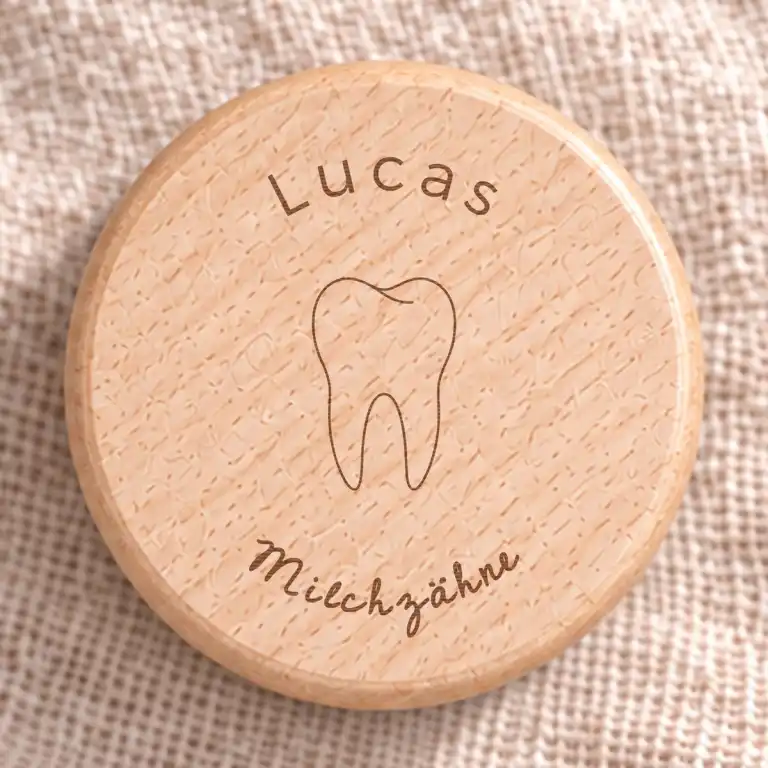
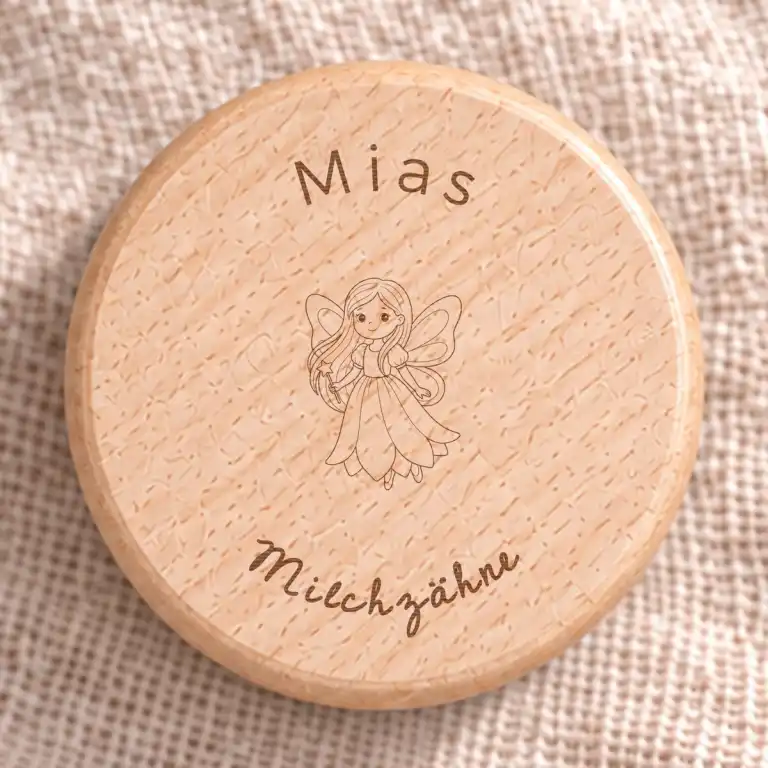
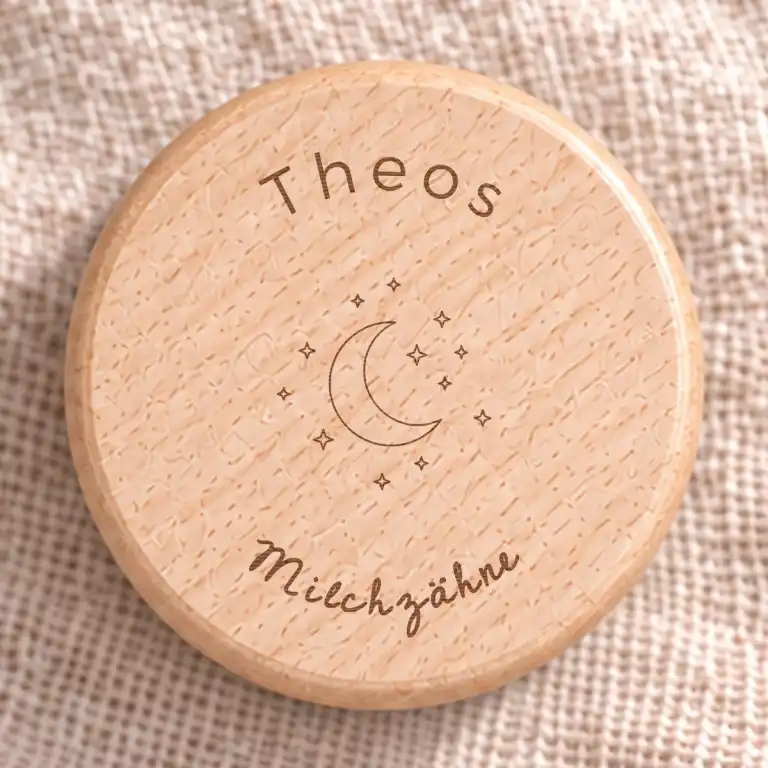
For keeping them, I make tooth boxes from beech wood in my workshop in Bergisch Gladbach. The lid is Ø 50 mm and engraved with the motif, the lettering "Milchzähne" (milk teeth) and your child's name. The tooth box "Tooth" shows a simply drawn tooth, the tooth box "Fairy" a little fairy with delicate wings, and the tooth box "Moon and Stars" a slim crescent moon among stars. Each costs €11.90. They're keepsake boxes, not toys, so they belong on a shelf rather than in the toy box.
Sources (in German)
- proDente: Zahnwechsel bei Kindern
- proDente: Kinder und Zahnwechsel: Tschüss Milchzahn
- KZBV: Das natürliche Gebiss
- kindergesundheit-info.de: Zahnentwicklung
Accessed on 27 October 2026.